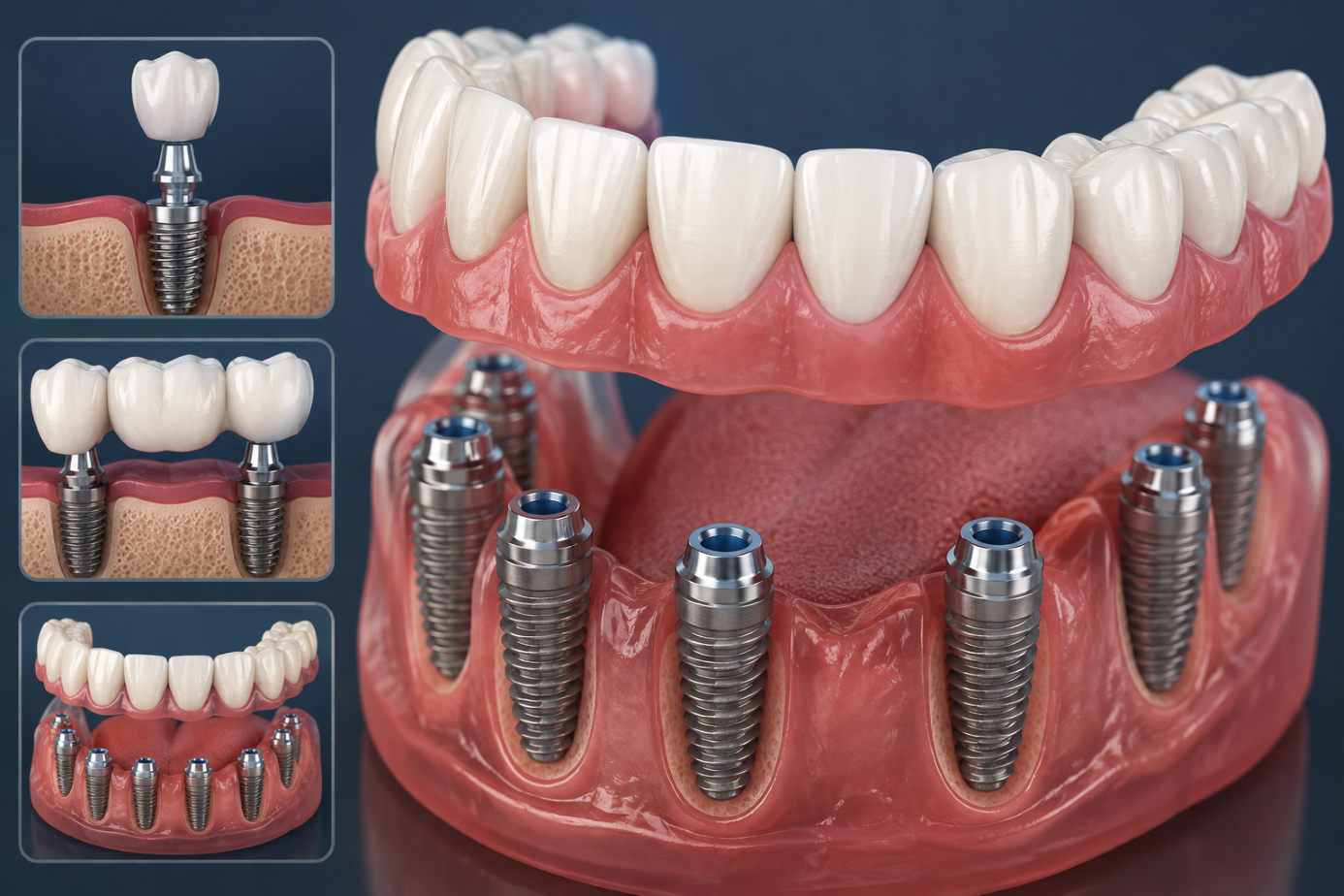
If you have 12 missing or damaged teeth, you may assume that each tooth needs its own dental implant. However, this is not always necessary. The number of implants required depends on the location of the missing teeth, the condition of your jawbone, your bite, the type of restoration planned and your overall treatment goals.
So, do you always need 12 implants for 12 teeth? In many cases, the answer is no.
Does Every Missing Tooth Need Its Own Implant?
No. A dental implant replaces the root of a missing tooth, but one implant does not necessarily have to support only one tooth.
Depending on the clinical situation, several implants can support a dental bridge or a larger implant-supported restoration. This means a dentist may be able to replace multiple missing teeth using fewer implants while maintaining appropriate stability and function.
The ideal number should be determined through a detailed examination and individualized treatment planning.
How Many Implants Are Needed for 12 Teeth?
There is no universal number of implants required to replace 12 teeth.
For example, if several neighboring teeth are missing, implants can sometimes be strategically positioned to support a bridge. In other situations, individual implants may be recommended for particular teeth.
The treatment plan may therefore involve:
- Individual implants supporting separate crowns
- Multiple implants supporting an implant bridge
- Implant-supported partial dentures
- A full-arch implant-supported restoration
- A combination of different restoration types
The best option depends on your anatomy, oral health and the number and location of missing teeth.
Why Don’t Dentists Simply Place 12 Implants?
Placing one implant for every missing tooth is not always the most appropriate solution.
Available Bone
Dental implants require sufficient bone volume and quality for predictable placement. If multiple implants are placed close together, there may not always be enough suitable bone to position every implant ideally.
Bone grafting or other procedures may sometimes be necessary when there is insufficient bone.
Implant Position
The position and spacing of implants are important for both function and aesthetics. The dentist needs to consider the shape of the jaw, neighboring structures, bite and the final restoration when determining implant positions.
Type of Restoration
The number of implants also depends on what will be placed on top of them. A series of individual crowns may require a different implant configuration from a fixed implant-supported bridge.
Overall Treatment Complexity
More implants do not automatically mean a better treatment outcome. The objective is to use an appropriate number of strategically positioned implants to provide stability, function, aesthetics and long-term maintainability.
Can Fewer Implants Support 12 Teeth?
Yes, in appropriate cases, several implants can support a restoration that replaces more teeth than the number of implants.
For example, an implant-supported bridge can replace multiple adjacent teeth while being supported by implants positioned at strategic locations.
This approach can reduce the number of surgical sites compared with placing an individual implant for every missing tooth.
However, fewer implants are not automatically suitable for every patient. The dentist must assess bone availability, bite forces, implant position and the design of the final restoration.
What About Full-Arch Implant Treatment?
When a patient is missing most or all teeth in one arch, a full-arch implant restoration may be considered.
In these situations, a fixed prosthesis can be supported by strategically placed implants rather than using an implant for every individual tooth.
This treatment concept can be particularly useful when many teeth are missing or when the remaining teeth have a poor long-term prognosis.
The exact number of implants varies depending on the treatment design, anatomy and clinical requirements.
Is It Better to Have More Dental Implants?
Not necessarily.
The success of implant treatment depends on more than simply the number of implants. Important factors include:
- Implant position
- Bone quality and volume
- Gum health
- Bite and chewing forces
- Implant stability
- Quality of the prosthetic restoration
- Oral hygiene
- Patient-specific anatomical factors
- Proper treatment planning
A carefully planned treatment with strategically positioned implants can be more appropriate than simply placing the maximum possible number of implants.
How Does a Dentist Decide How Many Implants You Need?
A comprehensive examination is required before an implant treatment plan can be created.
Your dentist may evaluate:
Clinical Examination
The dentist examines your teeth, gums, bite and overall oral health.
Dental Imaging
X-rays and three-dimensional imaging, such as CBCT scans, may be used to evaluate bone volume and important anatomical structures.
Digital Planning
Digital impressions, intraoral scans and other digital records can help the dental team plan implant positions and the final restoration.
Prosthetic Planning
The dentist should consider the final teeth before determining where implants should be placed. This is sometimes described as prosthetically driven implant planning.
The objective is to position implants in locations that provide appropriate support for the planned restoration.
What If I Don’t Have Enough Bone for Implants?
Insufficient bone does not necessarily mean that dental implants are impossible.
Depending on the location and severity of bone loss, procedures such as bone grafting or sinus augmentation may sometimes be considered.
However, not every patient requires additional bone procedures. Modern implant planning should first evaluate the available anatomy and determine whether implants can be positioned safely and predictably.
Does Implant Number Affect Treatment Time?
It can.
Placing multiple implants may involve more surgical sites and can affect the complexity of the treatment. However, treatment time depends on much more than the number of implants.
Factors such as bone grafting, healing requirements, implant stability, temporary teeth and the type of final restoration can all influence the treatment timeline.
Your dentist should provide a personalized treatment schedule after evaluating your case.
What Questions Should You Ask Your Dentist?
If you are considering implants to replace 12 missing or damaged teeth, ask your dentist:
- How many implants do I actually need?
- Why is this number recommended for my case?
- Can an implant-supported bridge replace multiple teeth?
- Do I have sufficient bone for implant placement?
- Will I need bone grafting?
- What type of restoration will be placed on the implants?
- How will my bite be considered?
- What are the treatment stages?
- How long will the complete treatment take?
- What are the alternatives to multiple individual implants?
Understanding the reasoning behind your treatment plan can help you make a more informed decision.
Frequently Asked Questions
Do I need 12 implants if I am replacing 12 teeth?
Not necessarily. The number of implants required depends on the location of the missing teeth, available bone, bite, restoration design and individual treatment needs.
Can 6 implants support 12 teeth?
In selected cases, strategically positioned implants may support a restoration that replaces multiple teeth. Whether this is appropriate depends on the patient’s anatomy and the design of the prosthesis.
Can 4 implants replace 12 teeth?
In certain full-arch treatment concepts, fewer implants can support a fixed restoration replacing many teeth. However, the appropriate number must be determined individually by the dental team.
Are more implants always better?
No. The goal is not necessarily to place as many implants as possible. Implants should be positioned strategically to provide appropriate support for the planned restoration.
How is the number of implants determined?
The dentist considers bone volume, implant position, bite forces, oral health, the number and location of missing teeth and the type of final restoration. Digital imaging and treatment planning can help determine the appropriate implant configuration.
Final Thoughts
Replacing multiple missing teeth does not automatically mean that an implant is required for every tooth. In suitable cases, strategically positioned implants can support bridges or larger fixed restorations.
The key question is therefore not simply “How many teeth am I replacing?” but rather “What implant configuration will provide the most appropriate support for my final restoration?”
A comprehensive examination, appropriate imaging and prosthetically driven treatment planning are essential for determining the right approach for each patient.
Optimum Dental Turkey Advantages
Free Consultation
Contact Us for an Online or In-Person Consultation
During your consultation, you will receive:
✔️ A comprehensive dental examination
✔️ A personalized treatment plan
✔️ A full cost estimate and treatment strategy
Customer Care Manager
By communicating with our professional translators, we ensure that everyone receives health care comfortably.

VIP Services
Reach our clinic with luxury vehicles with our VIP Service and receive accommodation in luxury hotels.